
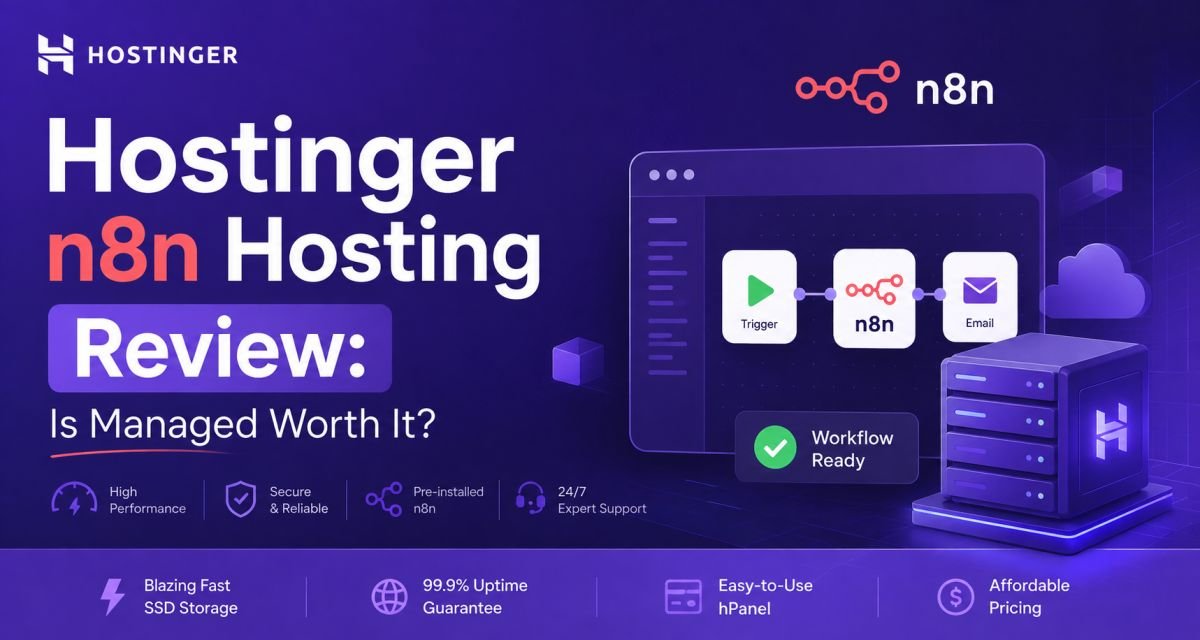
Hostinger Managed n8n is a middle ground between n8n Cloud and running n8n on your own virtual private server. Hostinger deploys the application in an isolated Docker container and handles server setup, backend security, software updates, and backups. You still design workflows, connect services, manage credentials, and troubleshoot your automation logic.
This is separate from Hostinger’s familiar n8n VPS templates. The managed product does not give you the clearly documented root access, server configuration, and resource choices of a VPS.
Hostinger Managed n8n is worth considering for solo operators and small US businesses that want always-on workflows without becoming server administrators. Its $5.99 advertised introductory rate is unusually low for managed deployment.
The largest drawback is incomplete specification disclosure. Hostinger does not currently publish a clear execution allowance, concurrency limit, bandwidth figure, supported-node policy, data-center choice, or managed n8n-specific service-level agreement. An official help-center screenshot shows 1 vCPU, 2 GB RAM, and 10 GB storage, but those specifications are not displayed prominently on the public pricing page.
This is a research-based evaluation of Hostinger’s current sales page, documentation, legal policies, n8n documentation, and relevant buyer discussions. No account credentials, controlled workload test, or long-term uptime data were supplied. Therefore, this review does not claim measured execution speed or reliability.
Hostinger’s global site accepts US customers in USD, and its current public AI Automation Apps page lists n8n as a purchasable application. However, Hostinger’s setup documentation says availability is still rolling out by region. US buyers should confirm that AI agents → n8n appears in their hPanel account or that checkout accepts their US address before relying on the service.
Product snapshot
| Category | Current details |
| Product type | Managed hosting for an n8n workflow-automation instance |
| Best suited to | Solo builders, consultants, and small businesses running modest internal automations |
| Deployment | Guided hPanel deployment into an isolated Docker container |
| Management included | Infrastructure setup, backend security, automatic updates, daily backups, logs, and restart controls |
| Documented resources | Official help screenshot shows 1 vCPU, 2 GB RAM, and 10 GB storage |
| Storage upgrade | Upgrade to 50 GB is documented; its price is not published |
| Integrations | Hostinger advertises more than 1,000 app integrations and scheduled operation |
| Execution limits | Monthly executions, concurrency, timeouts, and bandwidth are not publicly specified |
| Custom-node support | Not confirmed for the managed product |
| Introductory price | $5.99 per month equivalent on the displayed prepaid offer |
| Renewal | $11.99 per month equivalent, renewing for two years |
| Free plan or trial | None publicly listed; a 30-day money-back guarantee is advertised |
| US status | Sold in USD, but account availability may remain region-dependent |
Hostinger’s prices and plan details were checked on September 31, 2026.
Deployment and initial setup
After purchasing the AI Automation Apps subscription, you open n8n from the AI agents section of hPanel, select Add n8n, and wait while Hostinger prepares the workspace. You then open n8n and create the owner account with your name, email address, and password.
Hostinger may also offer a free n8n activation key for features such as advanced debugging, execution search, tagging, and folders. The documentation says that this prompt may appear, so these additions should not be treated as an unconditional paid-plan entitlement.
This process removes Docker installation, reverse-proxy configuration, operating-system patching, and command-line updates from the initial checklist. Hostinger claims deployment can take about 60 seconds, but that is a vendor estimate rather than a measured result from this review.
Building and configuring workflows
Inside n8n, you assemble workflows from triggers and action nodes. A trigger might receive a webhook, run on a schedule, or detect an event in another service. Subsequent nodes can filter information, transform JSON, call an API, update a database, send a message, or start another workflow.
The visual editor makes simple flows approachable, but n8n is not completely “no-code” in practical business use. Reliable workflows often require an understanding of OAuth permissions, API rate limits, webhooks, expressions, JSON structures, retries, and error branches. The HTTP Request and Code nodes provide flexibility when a built-in integration does not expose the operation you need.
A sensible learning path is to build a three-node workflow first, use test credentials, inspect every node’s output, and add an error workflow before activating it. Do not begin with an autonomous workflow that can send payments, delete records, or message an entire customer list.
Credentials, privacy, and security
n8n encrypts credentials before saving them to its database by using an instance encryption key. Hostinger also lets you add and edit environment variables through hPanel. Its interface can reveal stored environment-variable values to authorized hPanel users, so access to the Hostinger account itself must be tightly controlled.
Use separate service accounts where possible, grant only the scopes each workflow needs, enable multifactor authentication on connected services, and rotate tokens when a contractor or employee leaves. Avoid placing secrets directly in workflow text fields when an n8n credential type is available.
“Managed security” does not make every workflow compliant. Hostinger has not published a managed n8n data-center selector or product-specific guidance for HIPAA, PCI DSS, regulated financial data, or other sensitive US workloads. Businesses with legal data-residency or audit requirements should obtain written confirmation before connecting production information.
For AI workflows, place human approval before consequential actions such as sending external messages, changing customer records, issuing refunds, or deleting data. n8n supports approval-oriented steps, while its security audit can identify unprotected webhooks, risky nodes, community nodes, and outdated instances.
Backups, updates, and operational controls
Hostinger creates one backup per day and retains backups for seven days. You can restore an application backup or download it. The dashboard also exposes the installed n8n version, application status, disk use, logs, restart and delete controls, and AI-assisted log analysis.
Seven-day retention is useful for routine mistakes, but it is not a complete disaster-recovery policy. A daily schedule can leave nearly 24 hours of changes between backups, and Hostinger does not document a recovery-time target or exactly which credential and configuration components are included.
Maintain separate workflow exports and a secure inventory of connected accounts. Test a restore before the instance becomes business-critical.
Automatic updates reduce maintenance, but Hostinger does not publish an update delay, maintenance window, rollback policy, or staging environment for this plan. Check important workflows after version changes, particularly flows using OAuth, community packages, complex expressions, or external databases.
Resource and execution limits
The official dashboard screenshot shows 1 vCPU, 2 GB RAM, and 10 GB storage. Those are verified plan details, not evidence of throughput. Workflow capacity varies enormously: copying a few CRM fields is far lighter than processing files, controlling a browser, transforming thousands of records, or running several AI requests concurrently.
Hostinger does not state a monthly execution quota, maximum active workflows, concurrency ceiling, execution timeout, or bandwidth allowance for its managed plan. Consequently, “unlimited executions” should not be assumed merely because Hostinger uses that phrase on its separate self-hosted VPS pages.
Even without a billing quota, physical resources remain a limit. A one-minute schedule alone produces roughly 43,200 monthly runs. Downstream services can also throttle the workflow before Hostinger’s container reaches its limit.
Custom nodes, CLI access, and migration
Hostinger’s shared AI Automation Apps sales page lists CLI access, but the managed n8n help center documents only Dashboard, Environment, Backups, and Logs. It does not explain how n8n CLI access works or confirm that customers may install arbitrary npm packages.
Similarly, n8n identifies custom nodes as a self-hosted capability, but Hostinger has not published a managed-plan community-node policy. Buyers who require a specific custom node should obtain written confirmation before purchasing. The built-in HTTP Request node may be a safer substitute when an external service has a conventional API.
There is also no published managed n8n migration service. Workflow JSON files should be portable through n8n’s interface, but credentials may require recreation. Hostinger’s n8n Cloud-to-VPS instructions warn that Cloud exports use an inaccessible encryption key, preventing direct credential import into a self-managed destination. Plan to reconnect and test each credential individually.
Hypothetical use case 1: Lead routing
A US consultancy could receive a website-form webhook, validate the contact information, add the lead to its CRM, and notify the appropriate salesperson in Slack. An error branch could record failed CRM requests in a spreadsheet. This is a relatively light workload and a reasonable fit for the base resources.
Hypothetical use case 2: Invoice approval
A workflow could retrieve an invoice attachment, extract basic fields, check the supplier against an approved list, and send the result to a manager. Only after human approval would it create a draft accounting entry. This reduces repetitive data entry without allowing an unattended workflow to release funds.
Hypothetical use case 3: AI-assisted support triage
A small online business could classify incoming support messages with an external language model, look up order information, and prepare a draft response. A staff member would review the draft before it is sent. The language-model, email, ecommerce, and help-desk fees would remain separate from Hostinger’s hosting charge.
Pricing and total cost
The following prices were verified on August 31, 2026. Hostinger displays monthly equivalents but charges the selected subscription term upfront.
| Offer | Billing duration | Advertised rate | Upfront payment | Renewal | Usage and extras |
| AI Automation Apps introductory offer | 24-month displayed configuration | $5.99/month | $143.76 | $11.99/month for another two years, or $287.76 upfront | 1 vCPU, 2 GB RAM, 10 GB storage shown in official documentation |
| Other subscription durations | Selected during checkout | Not publicly itemized | Unknown | Unknown | Confirm the cart before payment |
| Storage upgrade | Not disclosed | Unknown | Unknown | Unknown | Raises documented storage ceiling to 50 GB |
The public page also shows a crossed-out $21.99 reference price, but the explicitly stated renewal is $11.99 per month for two years. The renewal figure is the more useful long-term comparison.
Potential additional costs include:
- State or local taxes calculated from the US billing address.
- OpenAI, Anthropic, Gemini, or another model provider.
- SMS, phone, email-delivery, scraping, search, database, or storage services.
- Paid editions or features from connected CRMs and business applications.
- The undocumented 50 GB storage upgrade.
Hostinger’s broad sales page says AI credits are included in the shared AI Automation Apps plan. However, its current help center specifically assigns integrated AI-provider controls and channel settings to OpenClaw and Hermes, while the managed n8n dashboard has only Dashboard, Environment, Backups, and Logs. Until checkout or support confirms otherwise, do not reduce an n8n project’s external API budget based on the generic AI-credit claim.
No conventional free trial is advertised. Instead, Hostinger promotes a 30-day money-back guarantee. Its refund rules exclude LLM and web-search credits, and purchased credits can be deducted from an AI Automation App refund. A processed refund terminates the service, so export everything first.
“Cancel anytime” normally means disabling automatic renewal. Outside an eligible refund, the prepaid service remains active until expiration; it does not imply a prorated refund for unused months.
Strengths, limitations, and alternatives
Strengths
- Fast deployment without manual Docker or operating-system administration.
- Low introductory cost for a managed, always-on n8n instance.
- Daily downloadable backups with restore controls.
- Environment-variable management, application logs, restart controls, and version visibility in hPanel.
- Automatic infrastructure, security, and software updates.
- Ability to switch the subscription to another supported automation app later.
Limitations
- No published execution, concurrency, bandwidth, or timeout limits.
- Modest documented base resources and only 10 GB of initial storage.
- Custom and community-node support remains unconfirmed.
- No managed n8n-specific migration guide, data-center selector, SLA, or detailed backup-scope statement.
- No documented root, database, file-system, or encryption-key access.
- Generic plan claims about CLI and AI credits do not align cleanly with the n8n-specific help pages.
- Switching applications requires deleting the current app; data and configurations do not transfer, and there is no refund or proration for the switch.
- The product documentation is new, so credible long-term managed-plan performance reports are not yet available.
Two recent community discussions illustrate common buyer concerns: self-hosting can turn an automation consultant into an accidental server administrator, while AI and connected-service subscriptions may still add substantial cost. The managed plan addresses the first issue better than the second.
Comparison with the two main alternatives
| Option | Current cost for US comparison | Main advantage | Main trade-off |
| Hostinger Managed n8n | $5.99/month introductory; $11.99 renewal | Hostinger handles infrastructure, updates, security, and backups | Low control and several undocumented limits |
| Hostinger self-managed KVM 1 VPS | $6.49/month on a two-year prepaid term; $11.99 renewal | 1 vCPU, 4 GB RAM, 50 GB NVMe storage, 4 TB bandwidth, root access, and community nodes | You are responsible for server security, updates, monitoring, and n8n recovery |
| n8n Cloud Starter | Approximately $23.29/month with annual billing, or $27.94 monthly | First-party hosting, published limits, collaboration, AI credits, and a no-card trial | 2,500 monthly executions, five concurrent executions, and less infrastructure control |
Hostinger’s VPS pricing and specifications are separate from the managed plan and must not be treated as included managed resources.
n8n currently publishes Starter at €20 per month billed annually or €24 with monthly billing. The USD estimates above use the European Central Bank’s August 28, 2026 reference rate of €1 to $1.1643; the card issuer’s conversion and fees may differ. Starter includes 2,500 workflow executions, five concurrent executions, unlimited users, and 2,300 monthly AI credits.
Choose the managed Hostinger product when your priority is avoiding server work and your automations are small enough to validate during the refund period. Choose the Hostinger VPS when you need root access, custom nodes, larger documented resources, another database, or control over updates. Choose n8n Cloud when first-party support, published quotas, collaboration features, and an ordinary free trial matter more than the lowest price.
Avoid the managed offering for regulated data, mission-critical workloads, client-facing n8n access, strict recovery objectives, or applications requiring guaranteed concurrency until Hostinger answers the missing technical and contractual questions. Agencies hosting workflows and credentials for clients should also review n8n’s licensing requirements; n8n says that arrangement may require an Enterprise license.
FAQs
Is Hostinger Managed n8n available in the United States?
Hostinger sells services to US customers through its global USD site, where n8n is currently listed as an AI Automation App. Nevertheless, the setup documentation describes the managed service as rolling out by region. Confirm that the n8n option appears in your account or completes checkout with your US billing address.
Does the managed plan include unlimited workflows and executions?
Hostinger does not publish a workflow count, monthly execution allowance, or concurrency ceiling for the managed product. It therefore should not be described as unlimited. The separate VPS offer advertises unlimited workflows and concurrent executions, but those claims and specifications cannot be transferred to the managed plan.
Can I install community or custom n8n nodes?
Possibly, but current Hostinger documentation does not confirm it. The generic plan page mentions CLI access, while the managed n8n guide does not document CLI or package installation. Ask Hostinger about the exact package before buying. Use a built-in node or HTTP Request node when possible.
Are OpenAI and other external API charges included?
Assume they are not. Hostinger’s n8n-specific documentation does not provide the integrated AI-provider controls documented for its other managed apps. OpenAI tokens, SMS messages, email delivery, search queries, databases, and connected SaaS subscriptions can generate separate charges and remain subject to each provider’s rate limits.
Can I export my workflows and credentials?
Workflows can generally be exported through n8n, and Hostinger lets you download application backups. Credential portability is less certain because credentials are encrypted with an instance key. When moving from n8n Cloud or another managed environment, expect to recreate credentials unless Hostinger confirms a supported encrypted migration procedure.
Final verdict
Recommendation: compare, then buy for a controlled trial—not immediate mission-critical deployment.
At $5.99 per month equivalent, Hostinger Managed n8n offers strong introductory value for light internal automation and removes most infrastructure work. Before committing important workflows, confirm execution and concurrency policies, custom-node support, server location, backup scope, and the 50 GB upgrade price.
Use the 30-day guarantee to recreate a real but noncritical workflow, measure peak behavior, test credential recovery, download a backup, and perform a restore. If those checks pass, the plan is an attractive low-maintenance option. If Hostinger cannot answer them, choose n8n Cloud for clearer managed limits or a VPS for full technical control.


Leave a Reply