
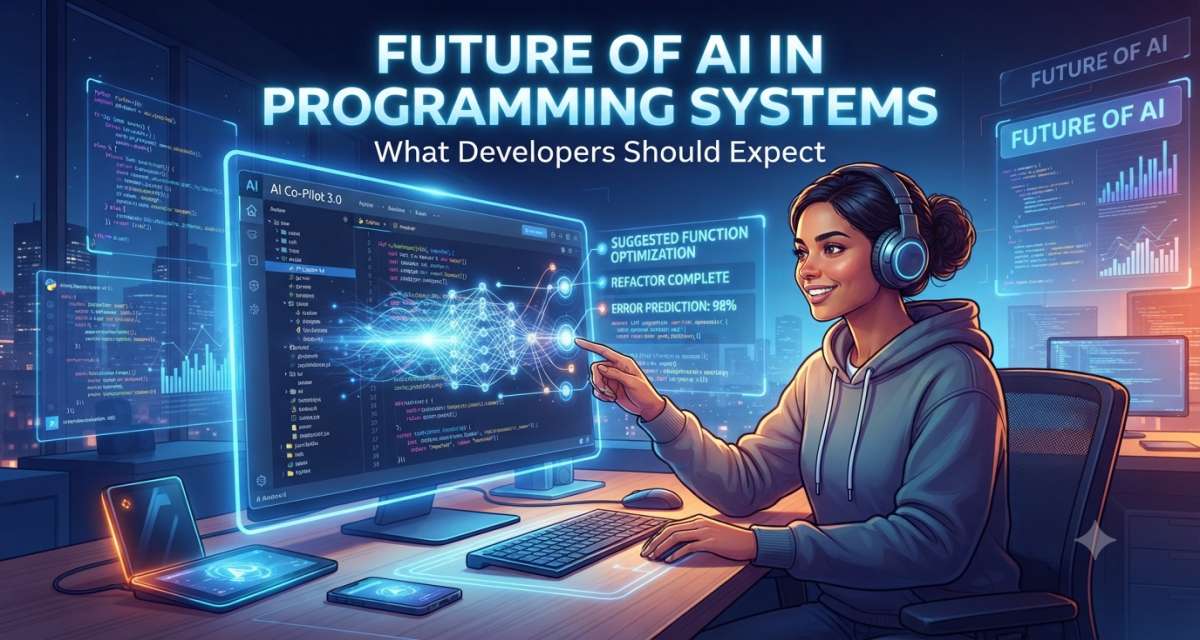
The future of AI in programming systems is not just about faster code generation. It is about a change in the full software environment: how tasks are planned, how code is written, how tests are created, how pull requests are reviewed, and how teams control quality.
The biggest shift is from AI as a typing assistant to AI as a software work partner.
Autocomplete helped developers write lines of code. Chat helped developers ask questions. Coding agents now read files, edit projects, run commands, fix errors, and prepare pull requests. OpenAI describes Codex as a coding agent that can read, edit, and run code, and its cloud version can work on tasks in a separate cloud environment. Anthropic describes Claude Code as an agentic coding tool that can read codebases, edit files, run commands, and work across multiple development tools.
That does not mean developers become unnecessary. It means the developer role becomes more focused on problem framing, architecture, review, testing, security, and product judgment.
As these agentic capabilities become the new standard, you can browse our curated best AI tools for website development to see which platforms currently offer these advanced, codebase-aware features
The practical answer: AI will change the system around coding
AI will affect programming systems by changing the tools and workflows used in software development. Instead of developers writing code only in an IDE, they will work with systems that can understand a repository, suggest plans, make edits, run checks, and request human approval.
As these workflows evolve, you can explore AI tools for developers to see how modern systems now handle planning, editing, and quality checks.”
A programming system used to include:
- a code editor
- compiler or interpreter
- package manager
- version control
- test runner
- CI/CD pipeline
- issue tracker
- documentation
AI adds another layer:
- codebase-aware assistants
- local coding agents
- cloud coding agents
- AI review helpers
- AI test generation
- AI documentation support
- context tools such as MCP
- policy controls for security and governance
GitHub’s documentation already shows this shift. Copilot cloud agent can be assigned development tasks through GitHub issues or prompts, then research the repository, plan changes, create a branch, and prepare work for review.
The future is less about “AI writes code” and more about AI participating in the software delivery chain.
From autocomplete to coding agents
AI programming systems are moving through three broad stages.
Assistant-level AI
Assistant-level AI helps with small tasks inside the developer’s flow.
Common examples include:
- completing code
- explaining a function
- suggesting a refactor
- creating a unit test draft
- summarizing an error
- writing a simple script
- generating documentation text
This stage is already common. It works well when the developer gives clear context and reviews the output.
The weakness is that assistant-level AI often sees only a limited part of the problem. It may answer confidently while overlooking a hidden dependency, a product rule, or a security issue.
Agent-level AI
Agent-level AI can take a larger task and work through several steps.
For example, a developer may ask:
“Find why the checkout discount test is failing, inspect the related files, propose a fix, update the test, and show me the diff.”
An agent may then:
- Search the project.
- Read related files.
- Identify likely causes.
- Edit code.
- Run tests.
- Adjust the fix.
- Present the result for review.
VS Code documentation describes agents that can plan an approach, edit files across a project, run commands, and self-correct until work is complete.
This changes how developers interact with tools. The developer becomes more like a reviewer, planner, and system director.
Team-level AI systems
The next stage is AI integrated into the entire engineering workflow.
That may include:
- AI agents assigned to GitHub issues
- Pull requests created by agents
- automated test suggestions during review
- security checks triggered from code changes
- Documentation updates linked to merged work
- Release notes drafted from commits
- support notes created from bug fixes
- repository policies that limit what agents can change
GitHub also supports third-party coding agents that can work on GitHub development tasks and create pull requests for review.
This is where AI becomes part of the programming system, not just a tool inside the editor.
What may programming look like in the next few years?
Programming will likely become more plan-driven, review-heavy, and context-aware. Developers will still write code, but a larger part of the job will be guiding systems that can produce code.
More planning before code
AI performs better when the task is clear. That means teams will need stronger issue writing, better acceptance criteria, and clearer technical constraints.
A weak task creates weak AI output.
Bad task:
“Improve dashboard performance.”
Better task:
“Investigate why the dashboard loads slowly for accounts with more than 5,000 records. Check API response time, database query behavior, and frontend rendering. Suggest a minimal fix and include tests or measurement notes.”
Future programming systems may help turn vague requests into clearer work items before code starts. AI can ask questions, identify missing acceptance criteria, and suggest risk areas.
More review after code
As AI creates more code, review becomes more important.
Developers will need to check:
- whether the change solves the real problem
- whether tests prove the behavior
- whether security rules are followed
- whether the code is maintainable
- whether the solution fits the architecture
- whether the AI changed unrelated files
- whether documentation matches the final result
A 2025 randomized controlled trial on experienced open-source developers found that, in that setting, AI tools slowed developers down rather than speeding them up. The study involved mature projects and experienced contributors, suggesting that the value of AI depends heavily on task type, codebase complexity, and workflow fit.
That finding is useful because it keeps the discussion realistic. AI can help, but it can also add review work.
More context-aware development environments
Future programming systems will not depend only on prompts typed into a chat box. They will use more project context.
That context may include:
- repository files
- open issues
- test results
- CI logs
- coding standards
- API documentation
- design files
- security policies
- database schemas
- deployment history
Model Context Protocol is one example of this direction. GitHub describes MCP as a protocol that can extend Copilot by integrating it with other systems.
For developers, this matters because AI output improves when the system has the right context. But context access also increases privacy and governance concerns.
More AI-generated tests and documentation
AI will likely become a regular part of test creation and documentation.
A future workflow may look like this:
- The developer writes or assigns a feature task.
- AI proposes implementation steps.
- AI drafts code changes.
- AI suggests unit and integration tests.
- Developer reviews the diff.
- CI runs tests and static checks.
- AI summarizes the pull request.
- The reviewer asks for changes.
- AI updates the patch.
- Documentation and release notes are drafted.
This does not remove engineering work. It moves effort into decision points.
What AI still struggles to handle
AI is strong at pattern-based coding, explanation, and draft generation. It is weaker when the task needs deep product judgment, hidden business context, or long-term architectural trade-offs.
Common weak points include:
- unclear requirements
- missing domain knowledge
- security-sensitive logic
- payment and billing flows
- permission systems
- data migrations
- distributed system failures
- performance trade-offs
- legal or compliance requirements
- multi-service architecture decisions
AI may also create code that looks clean but handles the wrong case. It can invent APIs, misunderstand project rules, or solve a simplified version of the problem.
This is why verification will matter more. A 2026 paper on skills for the future software profession argues that verification and validation become more important as agents handle more implementation work.
The future developer will need to ask better questions:
- What evidence proves this works?
- What case would break it?
- What did the agent assume?
- What files did it ignore?
- What security risk did it introduce?
- What test would fail if the fix were wrong?
How developer skills will shift
AI will not remove the need for programming knowledge. It will change which skills create the most value.
Reading code becomes as important as writing code
If AI produces more code, developers must become better at reviewing it.
That means stronger skills in:
- reading unfamiliar files
- checking logic paths
- spotting weak abstractions
- reviewing diffs
- finding hidden side effects
- understanding tests
- tracing data flow
A developer who cannot judge code quality will struggle to manage AI-generated work.
System design becomes harder to fake
AI can generate functions. It can suggest architecture. But it does not have long-term system health.
Developers still need to understand:
- data models
- service boundaries
- caching
- failure modes
- scalability
- observability
- dependency risk
- backward compatibility
AI may help explore options, but humans must choose the design.
Testing skill becomes a career advantage
Testing will become more valuable, not less.
Developers will need to know how to test AI-assisted changes with:
- unit tests
- integration tests
- end-to-end tests
- contract tests
- regression tests
- security tests
- manual exploratory checks
The question is not “Did AI create tests?” The question is “Do the tests prove the right behavior?”
Communication becomes part of programming
Future programming systems will reward developers who can clearly explain intent.
That includes:
- writing clear tickets
- giving useful prompts
- defining acceptance criteria
- reviewing AI plans
- explaining trade-offs
- documenting decisions
- giving precise feedback to agents
A vague instruction can create a long cleanup cycle. Clear direction can reduce wasted work.
What software teams should prepare now?
Teams do not need to rebuild everything at once. They should prepare for AI programming systems by improving the workflow around code.
A practical preparation checklist:
- Define approved AI tools.
- Decide which repositories agents can access.
- Set rules for sensitive data.
- Require human review for generated code.
- Track AI-assisted pull requests.
- Add clear acceptance criteria to tickets.
- Improve test coverage for high-risk flows.
- Teach developers how to review AI output.
- Keep changes small enough to inspect.
- Measure rework, defects, and review time.
DORA’s 2025 report describes AI as an amplifier of existing organizational strengths and weaknesses. It notes that returns depend on the system around AI, not only the tools themselves.
That point matters. If a team already has unclear tickets, weak tests, and slow reviews, AI may produce more work for the same broken system.
Risks that need serious attention
AI in programming systems creates real benefits, but it also adds new risks.
Code ownership gets blurry
Agent-authored code can make it harder to know who made a change and why. A 2026 study introduced a dataset of more than 900,000 agent-authored pull requests across GitHub repositories, showing that agentic PRs are already a large research topic.
Teams may need clearer rules for labeling, reviewing, and approving AI-assisted work.
Security mistakes can scale faster
A human may make one mistake. An agent may repeat the same insecure pattern across many files.
Teams should be careful with:
- authentication logic
- authorization checks
- input validation
- secrets handling
- dependency changes
- customer data access
- infrastructure scripts
AI can help find risks, but it cannot replace secure development practices.
Cost control becomes part of engineering
As coding agents become more capable, teams may use more tokens, cloud runs, model calls, and paid agent sessions. Recent industry reports note growing concern about token-based AI coding costs and the need for governance.
For managers, this means AI usage should be measured like any other engineering resource.
Junior learning may change
AI can help beginners learn faster by explaining code and giving examples. It can also weaken learning if beginners accept answers without understanding them.
New developers should use AI to ask:
- Why does this work?
- What are the alternatives?
- What error should I expect?
- How can I test this?
- What part of this code is risky?
Learning through AI should still involve writing, debugging, reading documentation, and reviewing mistakes.
FAQ
Will AI replace programmers?
AI will replace some repetitive coding tasks, but it is unlikely to replace skilled programmers as a whole. Developers still need to define problems, design systems, review code, test behavior, check security, and make product decisions. The role is shifting from only writing code to guiding and verifying AI-assisted work.
What are AI programming systems?
AI programming systems are development environments that include AI assistance across coding, testing, debugging, reviewing, documentation, and workflow automation. They may include IDE agents, cloud agents, code assistants, test generators, review tools, and integrations with issue trackers or CI/CD systems.
How will AI change software development?
AI will make software development more task-based and review-focused. Developers may assign agents to draft changes, run tests, and prepare pull requests. Human developers will spend more time clarifying requirements, checking architecture, reviewing output, and proving that the software works correctly.
Are AI coding agents reliable?
AI coding agents can be useful, but they are not always reliable. They may misunderstand requirements, change unrelated files, miss edge cases, or create weak tests. Teams should use small tasks, clear review steps, automated tests, and security checks before accepting agent-generated work.
What skills should developers learn for the AI era?
Developers should strengthen code review, testing, debugging, system design, security thinking, and technical communication. Prompting helps, but it is not enough. The most valuable skill is judging whether AI output is correct, safe, maintainable, and aligned with the product goal.
Is AI-generated code safe?
AI-generated code can be safe only after proper review and testing. Developers should check logic, security, dependencies, edge cases, and data handling. Sensitive code, credentials, customer data, and private system details should not be shared with unapproved tools.
What should companies do before adopting AI coding tools?
Companies should define approved tools, access rules, data policies, review requirements, and measurement methods. They should start with low-risk workflows, such as documentation drafts, test suggestions, or code explanations, before allowing agents to modify critical production systems.
Conclusion
The future of AI in programming systems will be shaped by agents, richer development environments, stronger context, and deeper workflow automation. Code generation will matter, but it will not be the whole story.
The most prepared developers will know how to define tasks clearly, review generated code, test deeply, protect sensitive systems, and make sound architecture decisions. The most prepared teams will improve their software delivery process before scaling AI across every repository.
For the next content step, create a separate tool-focused article, such as “Best AI Coding Tools for Developers,” or a practical checklist, such as “How to Review AI-Generated Code Safely.”


Leave a Reply