
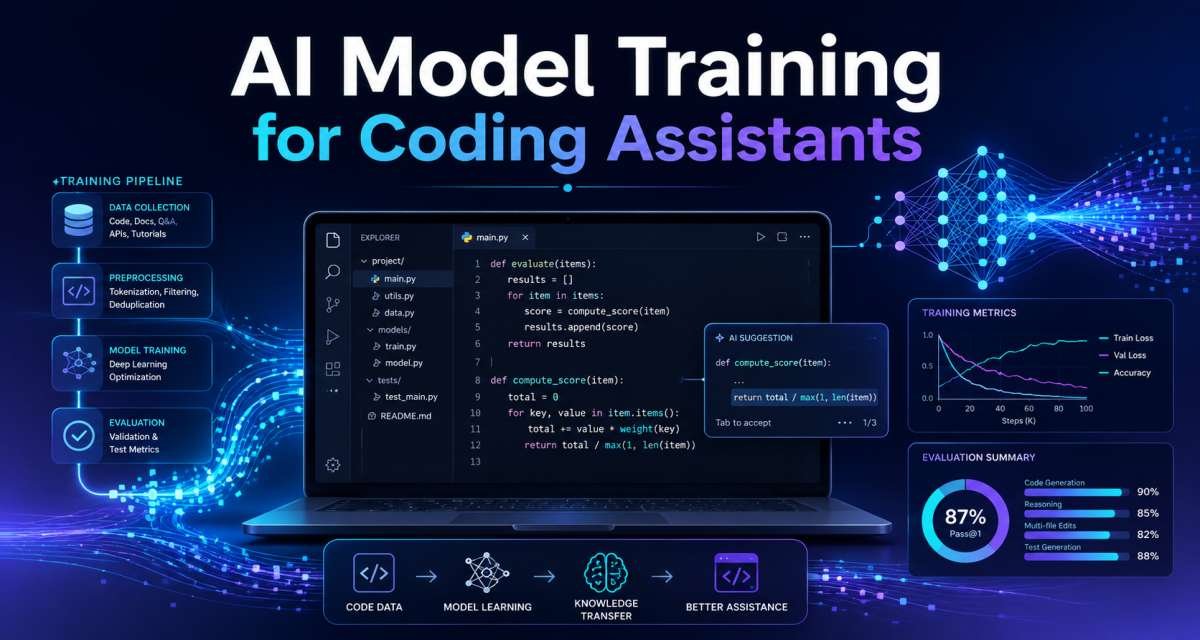
AI model training for coding assistants teaches a language model to work with a programming language, source code, technical documentation, developer instructions, tests, errors, and software-development patterns.
The goal is not simply to make a model produce more code. A useful coding assistant must connect natural-language requests with software patterns, follow instructions, generate or modify code, explain behavior, and work within technical constraints.
Training does not make the assistant equivalent to an experienced engineer. It can still generate outdated APIs, weak security patterns, incorrect assumptions, or code that does not fit a particular repository.
For developers and technical teams, understanding how these models are trained helps explain both their strengths and their limitations. It also makes it easier to decide when fine-tuning is useful, when repository retrieval is a better option, and what checks generated code should pass before it reaches production.
What Training a Coding Assistant Actually Means
A coding assistant is trained to predict, complete, transform, explain, and generate code from the context it receives.
That context may include:
- A natural-language instruction
- Existing source code
- Function names
- Comments
- Open files
- Error messages
- Tests
- Nearby modules
- Repository information
- API documentation
Suppose a developer asks:
“Create a Python function that validates an email address.”
The model uses patterns learned during training together with the current prompt to predict an appropriate implementation.
The same principle applies to more complicated tasks such as writing tests, explaining legacy code, fixing bugs, reviewing code changes, or translating code from one programming language to another.
What code models learn
Programming models learn relationships between language and software patterns.
For example, training may help a model recognize that:
- An Express route often receives request and response objects.
- A TypeScript function may require explicit types.
- A database query commonly needs input parameters.
- A test suite usually includes expected inputs and outputs.
- A framework follows certain naming and file-organization patterns.
- An error message may correspond to a known class of coding mistake.
The model also learns relationships between code and natural language.
A comment such as:
“Return only active subscriptions for this customer”
provides a signal connecting human intent with possible program behavior.
This is one reason coding models benefit from a mixture of code, documentation, comments, tests, technical discussions, and other developer material.
What training does not give the model?
Training does not automatically give a coding assistant complete knowledge of your software project.
It may not know:
- Your latest repository changes
- Internal APIs
- Business rules
- Current database schemas
- Security policies
- Deployment requirements
- Team naming conventions
- Approved dependencies
- Production incidents
- Private architecture decisions
Those details usually have to come from the current prompt, repository context, retrieval systems, tools, or additional adaptation.
This difference matters.
A model can produce code that is valid in isolation but wrong for the project in which the developer intends to use it.
Training improves the quality of the draft. It does not verify the final implementation.
What Data Coding Assistants Learn From
Coding models can learn from several types of technical material. The exact mixture depends on the model, provider, licensing choices, privacy policies, and training strategy.
The important point is that coding assistants do not learn only from raw source files.
Useful training signals can come from both software and the language developers use to describe software.
Source code and tests
Source code helps the model learn:
- Programming syntax
- Libraries
- Frameworks
- Common abstractions
- File organization
- Data structures
- Error handling
- API patterns
- Database access
- Common implementation techniques
Training material may contain languages such as:
- Python
- JavaScript
- TypeScript
- Java
- C#
- C++
- Go
- PHP
- Ruby
- Swift
- SQL
Code alone, however, does not always explain the intended behavior.
Tests provide another useful signal because they show what software is expected to do.
A function and its tests together can provide examples of:
- Expected inputs
- Expected outputs
- Edge cases
- Failure behavior
- Regression cases
- Validation requirements
Tests are therefore useful both during training and during later model evaluation.
Documentation and developer language
Natural-language material helps coding assistants understand developer instructions.
Relevant material may include:
- README files
- API documentation
- Technical tutorials
- Developer guides
- Code comments
- Error explanations
- Architecture notes
- Technical Q&A
- Function descriptions
This type of content helps the model respond to instructions such as:
“Explain this function.”
“Write tests for this method.”
“Refactor this code without changing behavior.”
“Return the result using this JSON structure.”
A coding assistant therefore combines programming patterns with language-following capability.
Issues, pull requests, and code changes
Real software engineering includes much more than completed source code.
Developers work with:
- Bug reports
- Feature requests
- Pull requests
- Review comments
- Commit changes
- Refactoring discussions
- Error reports
- Fixes
These materials can show a relationship between a problem and a software change.
For example, a bug report may describe an incorrect behavior, a patch may fix it, and tests may demonstrate the expected result.
That provides a richer training signal than isolated code because the model can see how developer intent connects to a change.
The quality of this data still matters. Repositories can contain broken code, outdated APIs, weak security practices, duplicated files, committed secrets, or inconsistent styles.
More training data does not automatically mean better training data.
How the Training Pipeline Works
Training a coding assistant is better understood as a pipeline than as a single step.
The supplied drafts describe a process that includes data preparation, pretraining, code-focused adaptation, instruction tuning, feedback, safety work, and evaluation.
Each stage influences the final behavior.
Data preparation and filtering
Training begins with data preparation.
Raw software repositories may contain material that a team does not want the model to learn from directly.
Examples include:
- Broken code
- Duplicate snippets
- Generated files
- Accidentally committed secrets
- Vulnerable patterns
- Obsolete APIs
- Low-value boilerplate
- Irrelevant files
- Inconsistent coding styles
Filtering attempts to remove or reduce these problems before training.
This stage matters because models learn patterns from the examples they receive. If weak patterns are common in the dataset, those patterns can appear in later output.
The same principle applies during company-specific adaptation. Training on inconsistent internal code will not reliably produce consistent internal code.
Tokenization and pretraining
Models do not process source code exactly as a developer reads it.
The training material is divided into tokens. Depending on the tokenizer, a token can represent a word, part of a word, punctuation, an operator, a keyword, or part of another code element.
During pretraining, the model learns to predict likely tokens from preceding context.
In code, that could involve predicting:
- A variable name
- A method call
- A closing bracket
- An import
- A function body
- A test assertion
- The next line in a code block
Across large amounts of training material, this process teaches relationships between programming structures and natural language.
Code-focused and instruction tuning
General pretraining creates broad prediction capability.
Additional code-focused training can strengthen performance on programming tasks such as:
- Function completion
- Code generation
- Test generation
- Bug fixing
- Refactoring
- Code explanation
- Language conversion
- Documentation generation
Instruction tuning then helps the model respond more directly to developer requests.
Example training instructions might resemble:
“Find the problem in this function.”
“Write tests for this API route.”
“Explain why this query fails.”
“Refactor this service without changing its public behavior.”
“Return the output in a defined structure.”
Instruction tuning is part of what turns a general code predictor into an assistant that can interact with developers through natural language.
Feedback, safety, and evaluation
Additional feedback can shape the assistant toward more useful behavior.
Feedback may come from:
- Human reviewers
- Automated tests
- Preference comparisons
- Security checks
- Code execution
- Model evaluations
The goal can include reducing undesirable output such as:
- Unsafe code
- Fabricated APIs
- Risky command suggestions
- Secret exposure
- Poor instruction following
Evaluation then tests whether the model actually improved.
This is important because a model may look strong in demonstrations while still failing on unfamiliar repositories or realistic software tasks.
Training therefore does not end when the model finishes processing a dataset. Evaluation determines whether the resulting behavior is useful.
Where Fine-Tuning Fits
Pretraining creates general capability. Fine-tuning is a later adaptation step designed to improve behavior for narrower tasks.
LLM fine-tuning for coding tasks means taking an existing model and training it further on selected examples that represent the behavior a team wants.
It is not the same as training a new foundation model from zero.
For example, a software team might want an assistant that consistently:
- Uses its standard API response structure
- Writes tests in the team’s preferred format
- Uses approved error classes
- Avoids a particular database pattern
- Reviews pull requests for specific validation problems
- Converts legacy code into a defined service pattern
If these requirements appear repeatedly, fine-tuning may help make the behavior more consistent.
When fine-tuning makes sense
Fine-tuning is most useful when the problem is repeatable and measurable.
Good candidates include:
- Repeated formatting or structure
The model repeatedly produces correct content in an inconsistent format.
- Team coding conventions
The assistant needs to follow stable naming, error-handling, architecture, or testing patterns.
- A narrow development task
Examples include writing one type of test, reviewing one class of code change, or converting code into one target pattern.
- Domain-specific software patterns
A team may repeatedly work with specialized internal workflows that a general coding model does not follow reliably.
- Secure coding patterns
A team can train on carefully reviewed examples of secure implementations and vulnerability fixes, while still keeping security testing and human review.
Fine-tuning is easier to evaluate when the task has a clear definition.
“Improve our coding model” is difficult to measure.
“Generate unit tests for Node.js service functions using our standard test structure” is much easier to evaluate.
When retrieval or prompting is better
Not every recurring problem requires fine-tuning.
If a model needs information that changes frequently, retrieval may be more appropriate.
Examples include:
- Current internal API documentation
- New database schemas
- Recent framework changes
- Latest project rules
- Current repository files
- Updated service contracts
Fine-tuning teaches behavior through training examples. Retrieval provides information at request time.
A useful decision rule is:
- If the model needs changing facts or project knowledge, consider retrieval.
- If it needs a stable repeated behavior, consider fine-tuning.
- If clearer instructions solve the problem, improve the prompt first.
- If it must operate inside a live repository, provide appropriate repository context and tools.
Fine-tuning versus repository context
Fine-tuning and repository context solve different problems.
Suppose a developer asks an assistant to add an endpoint to a private SaaS application.
A fine-tuned model may have learned the team’s general code style, but it may still not know:
- The latest route definitions
- Current validation helpers
- Existing service methods
- New database fields
- Recent tests
Retrieval can fetch those current files.
That means a useful coding system may combine several approaches:
- A capable base model
- Good instructions
- Repository retrieval
- Tool access
- Fine-tuning for stable behavior
Teams should not add every layer by default. Each one adds engineering and governance requirements.
Preparing Data for Coding-Specific Fine-Tuning
Fine-tuning depends heavily on example quality.
A random collection of internal code is not automatically a useful fine-tuning dataset.
The dataset should match the exact task the team wants the model to perform.
What good examples look like
A useful training example usually connects:
- The instruction or task
- The relevant context
- The ideal result
For code generation, an example might include:
- Task description
- Function signature
- Constraints
- Relevant context
- Correct implementation
For code review, it might contain:
- A code diff
- Relevant standards
- A useful review comment
For bug fixing:
- Error report
- Relevant source code
- Failing test
- Corrected patch
For test generation:
- Source function
- Expected behavior
- Approved test implementation
The examples should represent the behavior the team wants to repeat.
Poor training examples may include:
- Broken code
- Conflicting styles
- Incomplete context
- Weak tests
- Credentials
- API keys
- Customer information
- Incorrect solutions
- Unclear instructions
- Code that violates current standards
If these examples dominate the data, fine-tuning can make the model more consistent in the wrong direction.
Why evaluation data must remain separate
Training data and evaluation data serve different purposes.
The training set teaches the model.
The evaluation set checks whether the resulting model can perform on examples it did not train on.
A coding evaluation set may include:
- Normal tasks
- Difficult tasks
- Edge cases
- Security-sensitive cases
- Style-sensitive examples
- Regression cases from previous failures
Keeping these examples separate reduces the risk of confusing memorization with genuine improvement.
This also makes it possible to compare the fine-tuned model with the original base model under the same conditions.
Without a baseline and separate evaluation set, a team may spend time and money on training without being able to prove that the model improved.
How Coding Models Are Evaluated
Coding assistants should not be evaluated only by whether their answers look convincing.
Software has observable behavior.
An effective evaluation process therefore combines code execution, automated checks, repository-level tasks, security review, and human judgment.
Functional correctness
One of the clearest questions is whether generated code works.
Possible measurements include:
- Unit test results
- Integration test results
- Compilation success
- Type-checking results
- Runtime errors
- Lint results
- Expected output behavior
Function-level benchmarks can measure whether a model solves defined coding problems.
The drafts mention examples such as HumanEval and similar programming benchmarks. These can be useful for controlled comparisons, but isolated function tasks do not represent every difficulty found in real software development.
Passing a unit test also does not prove that code is secure or maintainable.
Repository-level performance
Real software work often involves multiple files, project conventions, tests, dependencies, and existing architecture.
Repository-level evaluations are therefore useful for testing tasks such as:
- Fixing bugs in an existing project
- Editing multiple files
- Following existing interfaces
- Understanding project context
- Passing an existing test suite
The supplied drafts reference benchmark families such as SWE-bench, SWE-PolyBench, SWE-Bench Mobile, and dialogue-oriented software-engineering evaluations as examples of attempts to measure more realistic development tasks.
The key lesson is not that one benchmark is definitive.
It is that production coding is harder to evaluate than small isolated functions.
Security and code quality
Correctness is only one dimension.
Generated code should also be assessed for issues such as:
- SQL injection
- Command injection
- Hardcoded secrets
- Unsafe deserialization
- Weak authentication logic
- Missing validation
- Unsafe file handling
- Dangerous dependency choices
Code quality evaluation can also consider:
- Readability
- Naming
- Duplication
- Error handling
- File organization
- Maintainability
- Test quality
- Conformance to team standards
A model can generate code that passes basic tests but remains difficult or risky to maintain.
Human and developer evaluation
Developers can identify issues automated tests may miss.
Questions for real users include:
- Did the output save time?
- Was it easy to review?
- Did it match the project architecture?
- Did developers need to rewrite large sections?
- Did it follow team conventions?
- Were its review comments useful?
- Did it create new security or maintenance problems?
This is particularly important for fine-tuned systems.
A tuned model may achieve better task-specific results while becoming less helpful outside its narrow training pattern.
The useful question is not simply whether the new model scores higher.
It is whether the model makes the target development workflow measurably better without creating unacceptable new risk.
Security, Privacy, and Training Risks
Coding assistants work with material that can be sensitive.
Source code can contain business logic, credentials, internal infrastructure details, customer information, security assumptions, unreleased features, and proprietary methods.
Training and adaptation therefore need data controls as well as machine-learning decisions.
Sensitive data and memorization
Training datasets should not contain secrets that the model should never reproduce.
Potentially sensitive material includes:
- API keys
- Tokens
- Passwords
- Private certificates
- Customer records
- Internal URLs
- Confidential code
- Production credentials
Fine-tuning can make this concern more direct because a company may be preparing examples from its own repositories.
Teams should decide:
- Which repositories may be used
- Who can prepare training data
- What must be removed
- Where training data is stored
- Who can access the resulting model
- Whether outputs are logged
Memorization is another concern.
If a model reproduces material from training examples too closely, sensitive or restricted information may appear in generated output.
That risk is one reason clean datasets and careful evaluation matter.
Insecure patterns and outdated code
Training data may contain old or unsafe code.
A model can reproduce patterns such as:
- Unsafe query construction
- Weak validation
- Outdated framework syntax
- Deprecated APIs
- Insecure authentication logic
- Unnecessary dependencies
Training on large quantities of source code does not automatically separate good engineering from bad engineering.
This is why coding models still need downstream testing, static analysis, security checks, and human review.
Fine-tuning can help reinforce approved patterns, but it does not create a security guarantee.
Licensing, ownership, and false confidence
Source-code licensing and ownership can affect how organizations use training data and generated output.
Teams should understand the relevant provider policies, company rules, and internal review requirements before using sensitive or licensed material.
Another risk is psychological rather than technical: fine-tuning can make a model appear more familiar with a team’s environment.
Its code may use the right naming style and file structure.
That can increase trust.
But familiarity does not prove correctness.
A model that sounds aligned with a codebase can still:
- Misunderstand business logic
- Miss a security boundary
- Generate broken code
- Use the wrong API
- Ignore concurrency
- Introduce a poor dependency
- Write weak tests
A more customized model still requires independent verification.
What Training Quality Means for Developers
Model training matters because it influences the usefulness of the first answer a developer receives.
Better training can improve:
- Code completion
- Explanations
- Test suggestions
- Refactoring help
- Bug-fix suggestions
- Review comments
- Instruction following
However, the useful measure is not how much code the model generates.
It is how much reliable engineering work the developer can complete with its assistance.
Code generation and testing
A better coding model may produce more relevant initial code.
For example, it may generate TypeScript instead of generic JavaScript when the project clearly uses TypeScript.
It may also identify useful test cases.
For a password reset flow, an assistant might suggest checking:
- Expired tokens
- Reused tokens
- Invalid users
- Rate limits
- Delivery failures
These suggestions can reduce repetitive planning work.
Developers still need to decide whether the tests reflect the actual product rules.
Framework and repository fit
Training can help with common framework patterns, but frameworks evolve.
A model may know a library yet suggest an older usage pattern.
Repository context becomes important when local conventions matter.
A team should therefore judge coding assistants on its actual:
- Language
- Framework
- Architecture
- Test stack
- Repository size
- Security requirements
- Code review process
An impressive general demonstration may not predict performance inside a specific production codebase.
Real workflow usefulness
Coding assistants can support several stages of development:
- Code completion
- Code explanation
- Test drafting
- Bug investigation
- Pull request review
- Documentation
- Refactoring suggestions
The best use cases are usually bounded enough for developers to verify.
A small helper method can be reviewed quickly.
A large generated subsystem may require so much investigation that the apparent speed advantage disappears.
This is another reason model quality should be measured through developer workflow rather than code volume.
A Practical Adoption Framework for Engineering Teams
Model training quality is only part of safe coding-assistant adoption.
The surrounding engineering workflow decides what eventually reaches production.
Start with bounded tasks
Low-risk, reviewable tasks make good starting points.
Examples include:
- Explaining unfamiliar code
- Drafting unit tests
- Writing documentation
- Suggesting small helper functions
- Creating refactoring ideas
- Summarizing code changes
- Drafting API examples
More sensitive areas need stronger review.
Examples include:
- Authentication
- Authorization
- Payments
- Encryption
- Database migrations
- Infrastructure scripts
- Production configuration
- Security-sensitive services
This does not mean AI cannot assist with these areas.
It means generated output should face controls appropriate to the consequences of a mistake.
Keep automated and human checks
AI-assisted code can pass through the same engineering gates as human-written code.
Relevant checks can include:
- Unit tests
- Integration tests
- Type checking
- Linting
- Static analysis
- Secret scanning
- Dependency scanning
- CI/CD checks
- Code review
- Security review where necessary
Generated tests also need review.
A test file can compile and pass while asserting the wrong behavior.
Developers should confirm that tests would fail when the implementation violates the intended requirement.
Measure quality rather than code volume
The amount of generated code is not a useful success metric by itself.
Teams can instead examine:
- Review corrections
- Test failures
- Bugs after merge
- Security findings
- Acceptance without major edits
- Time spent rewriting output
- Developer feedback
- Repeated failure patterns
A coding assistant may write code faster while making reviews slower.
If so, the workflow has not necessarily improved.
The same principle applies to fine-tuning.
Training should have a measurable target before it begins.
Common Mistakes to Avoid
1. Assuming the model knows the complete project
Training gives general or task-specific patterns, not automatic awareness of a current private codebase.
Provide relevant repository context where needed.
2. Confusing fine-tuning with retrieval
Fine-tuning changes learned behavior.
Retrieval supplies current information during a request.
Use them for the problems they actually solve.
3. Fine-tuning before establishing a baseline
Without measuring the base model first, teams cannot clearly prove that training improved the target task.
4. Training on random internal code
More examples are not automatically better.
Examples should represent the specific behavior the model needs to learn.
5. Mixing training and evaluation examples
Keep an independent test set so improvement can be measured on unseen tasks.
6. Trusting passing tests as complete proof
Tests can miss security problems, architectural issues, weak abstractions, and maintainability problems.
7. Using outdated or insecure examples
Training data can reinforce weak programming practices.
Review and clean examples before adaptation.
8. Pasting secrets or sensitive code into unapproved systems
AI development workflows should follow company privacy, security, and data-handling policies.
9. Generating large features without review boundaries
Large outputs hide assumptions and are more difficult to verify.
Break work into smaller tasks.
10. Selecting a coding model only from benchmark scores
Evaluate models using the languages, repositories, workflows, and engineering requirements that matter to your team.
Conclusion
Training determines much of what a coding assistant can recognize, generate, explain, and suggest. The process can include broad pretraining, code-focused adaptation, instruction tuning, feedback, safety work, and evaluation.
Fine-tuning is one part of that process, not the answer to every coding-assistant problem.
Use it when a model repeatedly needs to follow a stable, measurable coding behavior and you have clean examples of the desired result. Use retrieval when the model needs current repository information, internal documentation, or changing technical facts. Improve prompts first when clearer instructions are enough.
Whatever approach you choose, keep evaluation close to real software work.
Run the code. Run the tests. Check security. Review dependencies. Compare the result against the existing model. Let developers judge whether the assistant reduces work rather than merely producing more code.
A coding assistant becomes useful in production when model capability and software-engineering discipline work together.
FAQ
How are AI coding assistants trained?
AI coding assistants are trained using combinations of source code, technical text, documentation, tests, developer instructions, and other software-related examples. Models may then receive code-focused training, instruction tuning, feedback, safety adjustments, and evaluation before deployment.
What is LLM fine-tuning for coding tasks?
It means training an existing language model further using examples of a specific programming behavior, such as generating tests, reviewing code, fixing certain bugs, or following a team’s coding conventions.
Is fine-tuning better than repository retrieval?
They solve different problems. Fine-tuning is useful for stable repeated behavior, while retrieval is better for current repository files, changing documentation, internal APIs, and other project-specific information that must remain up to date.
How much data is needed to fine-tune a coding model?
The supplied material does not define a universal number. A smaller set of clean, focused examples can be more useful than a larger noisy dataset. The correct amount depends on the task and should be judged through an independent evaluation set.
Can fine-tuning make generated code secure?
Fine-tuning can reinforce secure coding patterns when high-quality security examples are used, but it cannot guarantee secure code. Testing, static analysis, dependency checks, security review, and human verification are still required.
What benchmarks can be used to evaluate coding assistants?
Evaluation can include function-level benchmarks, unit-test-based tasks, repository-level bug fixing, multilingual tasks, and realistic developer workflows. The supplied drafts mention benchmark families such as HumanEval, SWE-bench, LiveCodeBench, SWE-PolyBench, and related repository-level evaluations.
Can a trained coding assistant replace software developers?
No. Coding assistants can draft code, generate tests, explain logic, and suggest fixes, but developers remain responsible for architecture, security, business rules, debugging, verification, and long-term maintenance.



Leave a Reply